Episode Transcript
[00:00:07] Speaker A: Welcome to Kendall speaks.
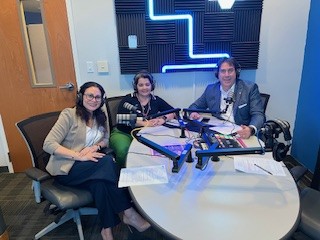
I'm Dr. Brian Stewart, Kendall campus president. And today we have a couple of students in one of our amazing chairs here on the campus.
Ms. Melissa Lesniak, Chairperson of Performing Arts and Industries.
[00:00:26] Speaker B: Welcome.
[00:00:27] Speaker C: Hi. Thank you.
[00:00:28] Speaker A: Glad to have you here today. And we also have Maggie. Help me with your last name. Maggie.
Okay, that's great.
Thank you. And then we have Victor Verde. All right, we're glad to have you guys here today.
And we're going to talk a little bit about our performing arts and industries area. And so let's first go around the room and tell us a little bit about your story, how you got to Miami Dade College. Tell us your path to the Kendall campus, if you would.
[00:00:50] Speaker C: I joined Miami Dade College and Sunday, September 2023.
Before that I was at the Arch center, and before that I was at, um. And before that I was at Greater Miami Youth Symphony, which actually used to rehearse here on Sundays. So I was very familiar with the building I oversee now. I spent like nine years on. On the weekend for rehearsals at the Kendall campus.
[00:01:16] Speaker A: Wow. And the Arch is a great place. That was. How long were you with the Arch Center?
[00:01:20] Speaker C: About two years.
[00:01:21] Speaker A: Two years. Well, I have Broadway tickets, or not Broadway, musical tickets every year, whatever they're called. So I love going there. Musical theater. That's what it is.
So my wife and I love going down there. And we just saw the Wiz, I think was the last one that they just did for the first of the season.
[00:01:38] Speaker D: Amazing. Yeah. That's a good production.
[00:01:40] Speaker A: Yeah. Well, glad to have you. You've been here since 2023, you said.
[00:01:43] Speaker B: All right.
[00:01:44] Speaker A: All right, Maggie, tell us about your journey, where you went to high school, how you got to the Kendall campus.
[00:01:49] Speaker D: Yeah, so I went to high school at South Miami Senior High school. I graduated 2020, and I took a couple years off because I wanted to make sure that coming to school was right for me, and it was right for me. And I started September 2023 as well, I think. Yeah, I've been here for two years. Almost. Three years. Almost. I'm hopefully graduating spring of 2026, and I'm a drama major, and I'm currently in a production that's going to go on this week.
[00:02:20] Speaker A: Starts on Thursday, right?
[00:02:21] Speaker D: Starts on Thursday. That's right. We have previews on Wednesday, and we've got two lead roles. We've got two people in the lead role. So we have one girl. Her name is Samantha. And I have. Next week, the 30th, the 31st, and the 1st of November.
Our show is called Mauritius and we're really excited to show everyone what we've been working on. Yeah. And Professor Alpern is our director.
Really exciting work. And I'm a little bit nervous, but it's the good kind of nervous, you know, that's good.
[00:02:52] Speaker A: Well, Maggie, glad to have you here.
[00:02:53] Speaker D: Thank you for having me.
[00:02:54] Speaker A: Victor, tell us about your path to the Kendall campus.
[00:02:57] Speaker B: Well, I went to Corey Senior High school, graduated in 2024 as a part of the chorus program, Tenors for life.
And then I spent a year at Jacksonville University learning music technology. That was my major.
Sadly, the program was defunded. Ended up making my way back to Miami and then ended up coming here as my bridge to potentially graduate school, other colleges, other universities. Because MDC is honestly just a great place to earn credits and to find community quickly and quickly. That's basically it. Quickly.
[00:03:35] Speaker A: Okay, that's good. That's great. Let's first, Melissa, talk a little bit about our program here. You know, Kendall has such a rich tradition and you kind of mentioned it in your intro. And I've been here a little over a year and a half and one of the first things that I got to see was some of our performances. And so talk a little bit about the campus and sort of the mission and what we have here at the Kendall campus, if you will.
[00:03:57] Speaker C: Sure. The performing arts and industries department at Kendall is unique.
Most of the rest of the Miami Dade college campuses kind of house the performing arts under the arts and philosophies department. So they're typically much smaller, don't have the kind of performing ensembles we have. So we have a wide variety of ensembles taking place. We have our music business department.
We have theater, dance and music ensembles and productions.
So it's unique. We participate in campus wide events and bring that kind of extra spark to the background and to the front of all of our events, like spooky night this weekend.
And in addition to all the kinds of separate events we host for concerts.
[00:04:49] Speaker A: Yeah, we just finished Hispanic Heritage Month and your team was all over different.
[00:04:53] Speaker C: Events and they have one this Wednesday.
[00:04:56] Speaker A: Okay, that's right. The last one is coming up. Yeah, that's right. That's great. Let's talk a little bit how the performing arts contributes to student engagement. Maybe from your perspective. Then we'll have our two students jump in.
[00:05:06] Speaker C: Sure. Well, I mean, being in an ensemble just creates a lot more engagement than, you know, going to classes.
You're a part of something, you're preparing for a performance, you're giving Back to the community. You're making the environment of the campus richer by providing those opportunities for students and faculty in the area community to come onto the campus to hear those concerts and see productions.
[00:05:34] Speaker A: Kind of like Maggie was. Just admit talking a little bit about your student engagement and how it's impacted you.
[00:05:40] Speaker D: Well, I've been in various productions in my time here and I completely agree with you, Professor Lesnieuk. I think working in a group, in an ensemble, it teaches you that you're not the center of everything.
And that working collaboratively is as rich and fulfilling as being independent, sometimes even more. Because you really do, I think, learn the power of. I hope I'm making sense that you learn the power of just working together.
It's a lesson that you learn when you're a child, but it doesn't really click until you, you're much older. And you do understand that you cannot do everything on your own.
[00:06:18] Speaker B: I completely agree.
[00:06:20] Speaker D: It gets easier. You burn out easier that way when you're working alone. But when you work in a group, I think there's much more longevity.
[00:06:28] Speaker B: Yeah, it's like part of being part of that well oiled machine. I think sometimes it takes a village to raise a child. They say it takes a group to achieve an impossible feat.
And I think that when it comes to making art and making music, often an ensemble really allows us to make the audience feel, you know, I think that there's something so valuable in that. And like you said, it really teaches us that we're not really the center of anything. You know, life is just too short to want to be the lead every time. Sometimes you just gotta step back and let the art do itself, you know.
[00:07:07] Speaker A: And I think that's what attracts students to the Kendall campus is we have so many diverse programs in the arts and all allow students to experience a holistic experience. So that's really great.
Professor Lesniak, talk a little bit about the academic programs and pathways that are offered in the performing arts and how they prepare students for careers in arts and entertainment.
[00:07:27] Speaker C: Sure. So we have the associates, the AA for music and music education, Drama and drama education and dance, and then we have two music business degrees. One is more of the management side and the other is more of the production side. But we also have the audio technology certificate within music business, where that can be a standalone thing or we get you in with the certificate and then we convince you to stay and do the as. So those are the tracks we have right now. And students can transfer, you know, to do a bachelor's or some students might, you know, that might be what they need to go out and start working in the industry.
So.
[00:08:15] Speaker A: Well, those stackable credentials, important because it allows a student to experience what's going on and then, like you said, pursue the advanced degree. So that's great. Victor, talk a little bit about the passion that you've discovered through your performance. Can you share a story or an example of a student whose journey has helped you, helped you in the performing arts, or how it's helped just helped you in general?
[00:08:35] Speaker B: Yeah, absolutely. One of the most memorable experiences I've had has been actually through the CORAL Exchange program that they do with high schools. So when I was going to Corey Senior High School, we would actually go and have the opportunity to work with MDC's choir and sing alongside them, practice alongside them, perform for one another, witness just the awesomeness of what a college choir is, you know, as a high schooler, because, you know, high schoolers just don't got it like that, quite frankly. But what's so powerful about it is watching that moment when everything really clicks for us. You know, when we realized that being a part of a choir wasn't just about singing notes on a page at the same time as a bunch of other kids that are choir, quite frankly, there because they wanted to get into Corey Senior High School.
It's about, you know, dedication and teamwork and emotion. I watched peers and other visiting students alike come to understand what it truly meant to be a part of that machine with the least mechanical purpose possible, to make us feel something, to make us. To enthrall emotion in us. It's really about getting the audience and getting whoever you're performing to, even if it's for yourself, to get that visceral moment of, wow, this is just like what catharsis, if that's the word, feels like, you know, that's great.
[00:09:59] Speaker A: Maggie, do you have a story about your journey that resonates with how you've gotten to where you are today?
[00:10:04] Speaker D: I think being in college and being in your 20s can seem like such a torrential time in your life that, you know, you feel like everything is uprooted in a way and that you're learning who you are all over again, like you're trying to figure out who you are all over again.
I'm sure that you guys probably experienced something similar when you guys were coming of age and growing up. But what I think is also that it's college. It's like a great safety net, so you can try things and you can make mistakes. And there's really no failing.
There's just redirection and learning again and growing and growing. And I think that being in the drama pathway has taught me a lot about myself, and it's taught me a lot about failure, and that failure is okay. It is okay. It's necessary. I would think so, yeah. To be the person that I am today, I've had to fail multiple times, and it's not always pretty, and it's not what anyone wishes on themselves. But I think that I wouldn't trade who I am now for any of the lessons that I've learned.
Being in plays is difficult because you're in a play after hours. You're rehearsing Monday through Friday, and you're in school, you know, in the mornings and in the afternoon. So trying to balance all of my classes, extracurricular activities, it is difficult. Learning your lines is very difficult.
And that's something that I definitely do struggle with, But I think that the only way out is through. My professor always tells us that, you know, if you find yourself stuck through hell, he says, you don't stop. You keep going. You know, you want to get out of there.
And I carry that with me every day because I think that sometimes we like to get in our own heads, or I tend to get in my own head a lot. But being here, especially in Kendall campus, there's so many people that are so ready to help. It's just a lending ear, a professor, a librarian, an advisor, and it feels like a safety net. I feel like I can fail and it'll be okay because you guys want to have our backs.
I think that's been my experience here. Holistically, that's been my experience here for the last three years.
[00:12:13] Speaker A: Do you prefer plays or musicals or both?
[00:12:15] Speaker D: Ooh. Well, I haven't gotten to do a musical yet.
[00:12:17] Speaker A: Okay.
[00:12:18] Speaker D: The first production that I auditioned for was a musical we were doing working fall of 2023, and I made a mistake. Guys, don't do this. If you want to be in musicals, don't do what I did.
They asked if I could dance, and I said, sort of, kinda, but I kinda can. Like, I can learn.
And that was a mistake because I think they needed dancers, and I sold myself too short.
But I like it all. To answer your question, I do like it all.
I would be in a musical. I'd be in a play. If you get me on a stage and you have a light on me, I'll do it.
[00:12:55] Speaker A: Good answer.
[00:12:57] Speaker C: I heard they might have a musical soon.
[00:12:59] Speaker A: Oh, is that right?
[00:13:00] Speaker D: Oh, fingers crossed.
[00:13:02] Speaker A: I would attend that, like for spring, you think? Okay, well, I'm there.
We won't ask you to give it away if it's. Unless it's top secret.
[00:13:10] Speaker C: I don't think they finalize that yet.
[00:13:13] Speaker A: There's a lot of goes into selecting those, you know, a lot of copyrights and those kind of things too. It's not like you just pick one up and say were doing Les Mis and whatever.
[00:13:22] Speaker C: Yeah, we always have to pay for the rights.
[00:13:24] Speaker A: Yeah, exactly.
[00:13:25] Speaker D: Absolutely.
[00:13:26] Speaker B: My school did Lion King Jr. And that was like 25 grand.
[00:13:30] Speaker D: Yeah.
[00:13:31] Speaker B: It's like, whoa.
[00:13:32] Speaker D: Yeah. The Disney ones tend to be more expensive. And since our program, all the productions in our program are free to see. I'm sure that licensing is also a more complex situation than we would assume because the funding comes from the people who want to donate and word of mouth is our best friend. So if anybody wants to come and see Mauritius and donate five bucks, you guys can. So we can get licensing for a musical. I just have to put that pitch in there. Thank you.
[00:13:59] Speaker A: Professor Lesniak, talk a little bit about all the opportunities that exist for students. We've talked about performances, but there's also other things, probably like directing and just talk about kind of the holistic experience a student can get here at mbc.
[00:14:13] Speaker C: I mean, there's multiple ensembles students can be in. We have two jazz bands, one that rehearses in the afternoon and one that's called like the Night jazz band.
We have the concert band and the symphony.
We have multiple vocal ensembles, the more classical side and then the jazz and contemporary side. We have the R and B ensemble.
We have the Jubilation Ensemble, the dance group as well, as well as multiple productions in the theater department that students audition for. You know, there's also the opportunity to sign up and take lessons, private lessons or you know, beginning theory and music. If you just want to dabble and get a taste for the arts, that's great.
[00:14:58] Speaker A: I had the experience last.
In the last spring semester.
You may have sent it to me, but we had four of our students who were pianists, they that were doing their, I guess their final exam. And holy cow, was I impressed with the talent in that room. They each had four or five pieces that were just off the chain.
[00:15:14] Speaker B: Recycles are always.
[00:15:16] Speaker A: Oh, I just had never been to one. It was so impressive.
[00:15:19] Speaker D: I'd love to go to one that sounds.
[00:15:21] Speaker A: Well, it was very well attended. I don't know if you read that one, but it was. I think it Was an adjunct. That was the professor in the spring. It was the spring, I'm pretty sure.
[00:15:29] Speaker C: Oh, I was probably on maternity leave.
[00:15:30] Speaker A: Oh, okay.
[00:15:32] Speaker D: Congratulations.
[00:15:33] Speaker A: You are where you're supposed to be.
[00:15:36] Speaker C: Yeah, we have. The piano department has a lot of forums and they're always well attended.
[00:15:41] Speaker A: Yeah, they were really good. Well, let's talk about collaboration, which is really important, you know, in the creativity that goes along with it. Are there any interdisciplinary projects that any of you are familiar with or partnerships perhaps with other academic departments you'd like to share with us? Victor, you want to start?
[00:15:58] Speaker B: Yeah, yeah, for sure. I think one of the most interesting parts is that we've actually had collaborations with visual arts and media students who created projections of film elements for like performances. That's one of my favorite parts. I think that like when the Jubilation has dance performances, they often have lighting and background that goes into that. That's our visual arts. We have something, at least in my sound recording classes, not particularly interdisciplinary, but something called Aux Day where we all the artists show each other music. And my professor, Professor Philip Jones, love the man. He's actually working on getting the arts connected through a bunch of clubs, a songwriters group, a producers group, an R and B group, etc, etc, it's. It's really wonderful and it's preparing us for a modern creative industry. You know, Miami artists aren't really as connected as at least I want them to be. And Professor Jones is doing something about it and MDC is doing something about it, which I think is really wonderful.
[00:17:02] Speaker A: That's great. And you're a musician. Tell us a little bit about what you play and what you love to do.
[00:17:07] Speaker B: Okay, so yeah, primarily I'm a vocalist.
I play saxophone. I'm mean on the bongos.
But as of right now, I've actually been getting into producing now that I've been spending the last year and a half, you know, in production and music technology. I've been producing jazz and R and B, Latin, pop. It's. It's really honestly been such a journey and a blessing to have those nights where I'm going through like creative flow and I'm just sitting there and you know, with, with an instrument or being a vocalist, you kind of need the luxury of having, you know, an isolation booth, quite frankly, if you want to just get your feelings out in, in your house at 2 in the morning. But with production, you can just throw on your headphones and sit down with your mini lab and your laptop and just. And just spend your entire night not annoying your mother.
[00:18:05] Speaker A: Maggie, I bet you've seen some interdisciplinary collaboration in your time here, haven't you?
[00:18:10] Speaker D: So I think it's the productions that I've been in. I haven't been lucky enough to actually work with the other parts of the department, the most interdisciplinary work that I've been involved in. So I was involved in the Humanities Edge program, I think, two falls ago or something like that.
And it was all students under the humanities umbrella. So it wasn't just, you know, theater kids or, like musicians. It was artists and people who were studying to be librarians, which I didn't know that you could do that. That's so cool.
And I digital artists as well. And I got to speak to a lot of people that you typically wouldn't because usually when you're in your department, you stick with people that you know. But I learned so much from all of my peers, and it was really exciting to work. And we also were given a lot of exercises to see how our majors could align or how we can work together.
And you typically do find that there really isn't anything that you can't do with another collaborator. I think it's just about how creative you're willing to get and how abstract things can get to.
[00:19:21] Speaker A: As I hear you both talk, it made me remember this summer, Professor Waltz had his orchestra playing Beatles music, and we had a group of our singers singing oh, wow. And it was like 20 something songs. It was really. Did you get a chance to see it?
[00:19:35] Speaker C: No.
[00:19:36] Speaker A: It was really good. And so to your point, there's a lot of talent on this guy campus, and maybe we need to think more about how we can merge some of those groups.
[00:19:43] Speaker D: I agree. I agree.
[00:19:44] Speaker A: Let's talk about technology now. Chair Lesnia, talk a little bit about our technology that we have here and how it helps our students, and then we'll let them tell us what they've experienced.
[00:19:54] Speaker C: Sure. Well, the music business department is obviously very impacted by technology, and that's why we're also so happy to have, like, the Perkins grant this year so we can buy new stuff, because things always go like, you know, go out of date quickly now, these days, so updating our studio and our labs is crucial. And then just looking to the future, like how things like AI are going to affect the music industry.
That's something to, you know, that it's not exactly clear yet, but it's something that the industry has to think about.
[00:20:29] Speaker A: Yeah, right, Right. What have you two seen with technology?
[00:20:33] Speaker B: Maggie, you want to take this one first?
[00:20:34] Speaker D: I am not a techie I'm not. We have our wonderful tech people who really just do their very, very best with the equipment that we have got, which is amazing equipment. It's just that since we don't have a tech program, it's difficult to find people who are expertise.
We outsource a lot of alumni, a lot of MDC alumni to come in and to help us out. But as for technology, as an actor, I think a lot of the work that I do is mainly just my head in a script. I personally, I don't really dabble much with technology. I think I'm a grandma with my phone. I barely know how to connect things. I have trouble connecting my phone to my car sometimes. That's the sort of person that I am.
But that there is so much opportunity in theater with technology.
Absolutely. And I have seen a lot of production specifically from the New World campus. They have really amazing shows with all of their, like, amazing lights. You're just mesmerized with all of their wonderful work. And the work that we have here is really amazing too. Our light production is pretty cool to me. You know, it's usually you're blinded by the lights, like, literally, but it's. It's always in a good way. It's in a good way.
That's as. That's as far as I go with technology, really.
[00:21:59] Speaker A: That's okay.
[00:22:00] Speaker B: That's awesome. Firstly, I actually want to say shout out to the New World School of the Arts campus, because I actually went there my freshman and sophomore year of high school. Amazing, amazing shows, amazing staff, everyone. There are lovely people.
And the students are all incredibly nice. They're all very nice. To me, when I went there for high school, technology is honestly kind of completely changed the game, like making music. Like, we're at a point when where, you know, you needed an entire live band of talented musicians to produce even a snippet of music, like, even, like a ringtone. You needed, like you needed all the guys in there, right? But nowadays, like, even I myself am working on an episode and I. And I just started like a year and a half ago, and I decided, you know what? I'm. I want to do this and I want to make music. And so I'm doing that. And it's only happening because, quite frankly, like, technology has made it possible. Before, you needed thousands of dollars of hardware. Now I'm running FL Fruity Edition, and I'm making stuff that if I master it, it's gonna be, you know, studio quality. You know, it's possible.
And so I Think it's. It's really amazing because it's expanding the creative world for people. It's allowing more people to be creative in their own ways. And I actually think that the beautiful thing about theater is that you're never going to be able to AI a performance.
[00:23:23] Speaker D: That is true.
[00:23:25] Speaker B: You're never going to be able to do that. You're never going to be able to put a bunch of holograms on the stage. No one's going to want to watch it. But with music, to the average listener, I mean, AI music is just as good as the next thing.
Some people who have an okay ear can hear it, but mathematically, music is. Is pretty repetitive. You know, you got the one to the five to the four to the six.
[00:23:49] Speaker C: Well, Professor Jones has the commercial music ensemble now, which is mostly making music on, I think, the laptop.
[00:23:57] Speaker B: We b.
[00:23:57] Speaker C: Basically, we also have the DJ class, too.
[00:24:00] Speaker A: That's right.
[00:24:01] Speaker C: That's another way students.
[00:24:02] Speaker B: Live performance is something that, I mean, you can kind of AI live performance, but then it's not really live performance. That's another thing. Live DJing. I mean, there's something about a live set being performed that's just. It's just wonderful.
[00:24:14] Speaker D: I agree. I was at three points this weekend. I had a friend who was lucky enough to give me a guest ticket in.
[00:24:20] Speaker A: So lucky.
[00:24:21] Speaker D: I saw so many amazing live artists. Local artists, too, because their mission is to make sure that all local artists are represented as much as people who come from all over the world.
And it was very exciting. And live music, you can't beat it. It doesn't matter. I personally don't think it doesn't matter where you are. If you can get to a live show anywhere, even at a dive bar, you should do it. Because it's people. It's real people with real stories to tell and their instruments or their DJ boards or. What do you call it?
Yeah, a board.
[00:24:55] Speaker B: You can call it like a set.
[00:24:58] Speaker D: They're doodads.
They do the talking for them. And it's really cool. It's really cool to see.
[00:25:05] Speaker A: Yeah, technology is definitely helping us out. Let's talk a little bit about our departmental goals. What do you see in the future? If you had your crystal ball out, what do you see the next several years looking like?
[00:25:16] Speaker C: Well, I have my goals.
[00:25:18] Speaker A: That's what I want to hear.
[00:25:19] Speaker B: Make it through.
[00:25:20] Speaker C: I mean, I think, you know, I really want to do that. Bachelor's in Performing Arts and Education.
[00:25:26] Speaker A: Yeah.
[00:25:27] Speaker C: We start. We met with the business school to propose a music business concentration under the bachelor's in business, so then they don't have to transfer.
[00:25:37] Speaker A: That's good.
[00:25:39] Speaker C: And I would like. You mentioned tech.
I really would like to have a certificate in technical theater.
I think a long time ago the college had an as in that. And to get like a backstage job at the Arsh center, you don't need the as, you just need the skills. So if we had like a one year certificate, just go.
[00:26:00] Speaker A: And it could be stackable too.
[00:26:01] Speaker C: So that's a pretty good. I mean, if someone wants to stay, those are my goals.
[00:26:05] Speaker A: Well, those are great. Those are wonderful.
I'd like to go around the table now and talk about what advice you'd give a student. You know, we have an audience out there, people listening. What would you tell them about the, the Kendall campus? And what advice would you give them? That we'll start with you, Victor. Maybe things you've done that has gotten you to this point, you know, help our audience out. What would you tell them?
[00:26:24] Speaker B: Okay, for sure. I think the main thing is that there's never going to be a right time. You're never going to be ready. Start now. Start right now. Even if it's just downloading something and getting a looper on your phone that's free. Start now. Even if it's picking up a cheap recorder and learning just how to do the finger notes on a flute, Start now. Even if it's getting out of bed and just saying, today I'm gonna be better than I was yesterday, start right now. Because there's never gonna be.
Life is too short. Like I said earlier, life is just too short to wait.
[00:27:02] Speaker A: Okay, that's really good advice. Maggie. What advice would you give a potential student out there, things you've learned that might help them?
[00:27:09] Speaker D: Well, Victor brings up a very good point that you will never be ready. It's just a matter of jumping into the abyss and seeing if you can end up catching yourself at the very bottom.
I think a big lesson I learned is using all the resources that are around me. I think for my first year here, I didn't really speak to anybody, to an advisor, to my professors, or to the people in my department.
And I quickly realized that I could not do it by myself. I had to go out there and I had to ask people who knew because that's their job to know.
And I did. And I quickly got acquainted with the advisors, all of the advisors that we have at our disposal. I quickly got acquainted with the people at the access office, which they have given me such a. An amazing opportunity to really just use all of the tools that I have at my disposal. For a long time, I think I thought that if I just grunted it out, like, if I just did it all on my own and I didn't ask anybody for help, I could do it, and it didn't work. So I.
You know, I went in there and I asked, and they were very kind to me and really helpful, and they explained things as many times as you need them to. And I have seen a change in my academic results and also in how I see myself.
I put a lot of worth into who I am, into my academics. Like, there's a lot of worth attached there for me. And I see a lot of people that do the same. And if I could tell them one thing, it's, go talk to someone. Go to an office and ask, who can I talk to so I can get financial aid? Who can I talk to so I can fit my classes out for next semester? Which I think spring classes are opening up next week. Right. The.
[00:29:00] Speaker A: Tomorrow.
[00:29:00] Speaker D: Tomorrow.
[00:29:01] Speaker A: Today.
[00:29:02] Speaker D: Today.
[00:29:02] Speaker A: Today's the 20th. Yes.
[00:29:04] Speaker D: All right. All right.
[00:29:05] Speaker A: Depending on your. Yeah, depending on where you're.
[00:29:07] Speaker D: So I've got an advisor to talk to.
[00:29:09] Speaker A: There you go.
[00:29:09] Speaker D: Yeah.
[00:29:09] Speaker A: Right on time.
Professor Lesniak, any advice you would give? Any.
[00:29:14] Speaker C: I mean, there's so many opportunities for entry in our department. I mean, right now I'm teaching private violin lessons. Wow. And I have a student who. He was the band. He is the band director at South Dade Middle, but he also has to teach the orchestra, so he wanted to do it well. And he's coming to campus taking violin and cello lessons.
[00:29:42] Speaker B: That's a dedicated educator right there.
[00:29:44] Speaker C: So, you know, we have all kinds of entry points. We have lessons. You can take the DJ class.
[00:29:50] Speaker D: You can.
[00:29:51] Speaker A: Well, I'll give you a little shout out. I had a friend of mine that wanted to learn guitar, and you hooked him up, straight up. So appreciate that. And so that's a great point that just let us know. Let us know how we can connect students. I think that's great. I'd like to end the last question. Maggie kind of brought this up, but what are ways that our community can get involved in performances and volunteering and donating? What are other ways that people can get involved in our program?
[00:30:15] Speaker C: Well, all of our events, the concerts and productions are on the website, and the direct site is mdc. Edu. Onstage.
[00:30:25] Speaker A: Onstage. Okay.
[00:30:26] Speaker C: That's great. That's all of our upcoming performances.
[00:30:29] Speaker A: Any. Any advice from you two that you'd want to share about getting involved well.
[00:30:34] Speaker D: We'Ve got a curtain call club that was reinstated this year. So if you're somebody that wants to be involved in theater and whether your classes don't allow you to, your schedule, your life, you can still be involved some way. We have a lot of activities.
I think starting next month, it's gonna be, at the very least, every Wednesday.
[00:30:55] Speaker A: Okay.
[00:30:56] Speaker D: So you guys can come and you can say hi, and we just talk about the things that we like. I think we have some cool stuff planned. Maybe some. Some shows, like we'll watch some shows together and things like that. So it doesn't, you know, being involved doesn't necessarily mean that you have to do it all. You know, you don't have to be involved in the production if you can't. But you can do other things and, you know, you can be. You can keep in touch with people in your community.
That's one thing. I think another thing, too, is just usually I see people that they go to their classes and they go home, but staying on campus, there's always something. Always something happening. And I always see you, Dr. Stewart. I always see you either handing out cafecito or talking to students or we will have barbecues or just like, just great activities outdoors, which is really cool. Like, I've met some of my greatest friends at some of the stuff that we do out here after school. You're not isolating yourself. Right?
[00:31:59] Speaker A: Right.
[00:32:00] Speaker D: There is a price for a community, and sometimes it's a hard price to pay. Or maybe it's not something that we were all taught to be involved.
But I've quickly realized that being part of the community is, I think, one of the greatest gifts of my life. My friends.
But, you know, my chosen family, my chosen community, not just my family, my friends and my peers are some of the best people I've met and the people that have brought me to where I am today because I think they act as a great mirror. Your community acts as a great mirror for who you are and also for what the world can look like. It can be scary out there, but when you have people who believe in doing good, I think good can happen. Good can come of that.
[00:32:43] Speaker A: That's good. Very good. Victor, Anything?
[00:32:45] Speaker B: Wow. What a wonderful and thorough answer.
[00:32:47] Speaker D: Thank you very much.
[00:32:48] Speaker B: I think Maggie is my hashtag, favorite person.
Anyway, thank you. Anyway, sorry, guys. Super cringe at me, but I think the biggest thing you can do, like Maggie said, show up. Just show up.
Shouting out once again, a bunch of teachers, because I want to give specific examples. Mr. Bumpers, Mr. Quincy Jones. Mr.
Philip Jones. Wait, Steve Quincy. Steve Quincy. Why did I say that? Mr. Quincy. Mr. Jones. There we go. So nervous, guys.
[00:33:18] Speaker D: Can you tell it's Monday? It's Monday.
[00:33:19] Speaker B: It's Monday. Anyways, yeah, they are getting together clubs, they are getting together groups, they're getting together producers and singers and writers and conductors. I mean, in. In these clubs, classes, if you just walk over to Building 8 or Building M and you just sit down with one of these nerds, because we are all nerds. You have to understand that if you sit down with one of these nerds and talk to them, they will nerd out with you and you will learn something new. You will. You will want to become more engaged because of just how engaged they are with their craft. NDC is. Is, you know, like, the reason that so many people come here is because MDC really caters to people who are dedicated to their craft. And some people argue, oh, well, you know, I could be going to a private university or B place that's gonna, you know, charge you a million dollars every over the course of your four years. And I apologize that the highest quality place just so happens to also be affordable, and it just so also happens to be somewhere that's available to the community. But because that's what the best place is gonna be, it's not gonna be closed off to the elite musicians. It's not gonna be closed off to the kids from halfway across the country who can only afford to play because they're, quite frankly, you know, beneficiaries of the disparities of our nation and class and whatever. And that's for a different podcast.
MDC is for the community. It's for Miami. It's for Homestead. It's for Hialeah, it's for Cafecito. It's for, you know, and I think that's. That's the main part. Once you understand that MDC is for you, you're just gonna want to show up.
[00:34:59] Speaker A: Well, this has been great. We appreciate this conversation with. For being here today. We do like to end our broadcast by turning the microphone around on me. And we've been doing this at every podcast we've had. So if you'd like to ask me any question, I'm happy to try to answer it. So whoever wants to go first.
[00:35:16] Speaker D: You said you've been here for a year and a half, correct? You're originally from Texas? What part of Texas?
[00:35:23] Speaker A: I grew up in East Texas.
Fort Worth. Dallas is where I spent some time. And then I was the president of the medical Campus for six and a half years before I came to Kendall. So I've been at the college over.
[00:35:33] Speaker D: Seven years now for six and a half years. I think my mom went to the medical campus around that time. My mom is a respiratory therapist.
[00:35:41] Speaker A: Oh, great program.
[00:35:42] Speaker D: Yeah. And she got her degree when I was in high school. So I was. She was. She was a great example for me. She was in school and she was a mom and I was in school, and I was like, if she can do it, I can definitely do it.
Well, I just wanted to ask what your favorite part of being here in Miami and in Kendall campus, what that's been like.
[00:36:03] Speaker A: It's really a hard campus. A hard question to say, but what I will say, you know, being at the medical campus with respiratory care and all those programs.
What I love most about this campus is the students.
The minute I walked on this campus, it has a feel, and you have great faculty and administrators. And I just, I think the student population here is incredible. And regardless of what your major or what your degree is, there's someone here for you. There's someone here to be a mentor, like you were saying, to geek out with. And I just. I just love the feel of this campus. It really is an amazing campus. And when I go in the community, I've seen. Said this story a number of times, there's so many people in this community that went to this campus.
If they call it South Campus, you know, when they went, yes. If they say Kendall campus, you know.
[00:36:45] Speaker B: Yeah, my dad calls it South Camp.
[00:36:47] Speaker A: Yes. I had people all over that do that when they introduced me. Oh, I went to South Campus. But the stories and the impact that the Kendall campus, as well as Miami Dade College has had on people is just incredible, and it makes me happy to be here. So thanks for that question.
[00:37:01] Speaker C: Of course.
[00:37:01] Speaker A: Victor, you got one.
[00:37:03] Speaker B: This is coming from someone who's. I. Like I mentioned earlier in the. In the podcast, I work out of school. I work with kids. I want to get into education.
As an educator, what is the most important part of putting yourself in the mindset? To work with kids who may disagree with you, who are coming to you with. From. From a diversity of backgrounds. How do you put yourself in that mindset to. To honestly, like, hear anything? Like, because students will come at you with the most hard, heartbreaking stuff and like, how do you go to sleep at night without that, without that aching on your heart, you know?
[00:37:39] Speaker A: Well, I think the first thing you have to do is be a good listener, because that's the first thing Most people want is someone to listen to what they're doing. The second thing, as I think education and experience help you relate to that situation.
One of the things talking about putting your. I always say to myself, when I put my head down on the pillow, did I make that right decision? And so those are the kind of things that you have to develop that internal value system that helps you know that you made the right decision. And you can't. You can't make everybody happy. Trust me, I see it almost every day. I try. But then I have to make the best decision I can and know that when I put my head down at night, I was fair to everybody. And so that's what I would say, listen and then develop those skills to help solve those kind of problems. And no one's. You know, every day I have a different problem. That's what I love about my job. It's never the same day ever.
[00:38:28] Speaker D: So that's. That's great Southern hospitality.
[00:38:31] Speaker A: My Texas ness is coming out.
[00:38:32] Speaker D: You're right.
I think that that's a good. And the podcast, when my professor extended the invite to me and Dr. Lesniak extended this invite to me, I didn't even know you had a podcast. And I was like, man, man, oh, man, do wonders overseas. Because really, I think it's easy for people who are higher up in the chain to not really see their faces.
But I've seen your face more than I've seen some professors faces. I think that that's good.
It makes me feel good when I come into campus because I know that I know who you are and I know what you look like. And also that you have a podcast now.
[00:39:15] Speaker A: That makes me happy. I will give one advertisement that we have rooms that are open for any student anytime to do your own podcast.
[00:39:21] Speaker B: That's true.
[00:39:22] Speaker A: You don't have to come to mind. You're always welcome here. But I appreciate those kind words. But hopefully you all know that we're here for you.
[00:39:28] Speaker D: Yes. Thank you.
[00:39:29] Speaker B: What a wonderful resource at a wonderful school.
[00:39:32] Speaker A: Do you have a hard question for.
[00:39:33] Speaker C: Me or are you dressing up for Spooky Nights?
[00:39:36] Speaker A: I am, I am. And last year I was a hamburger.
My wife was a chef because I grill all the time.
[00:39:45] Speaker B: Very barbecue.
[00:39:46] Speaker A: This year. This year it will be Texas related. So if you come to Spooky Fest, you'll be able to see. I'll be a little taller than six.
[00:39:53] Speaker D: Four, actually, because what Texas football team do you like? Is it football related?
[00:39:58] Speaker A: Yes. Yes, it is, actually. My Dallas Cowboys whooped the. You know what out of the Washington commanders yesterday. So this is a great Monday for me.
[00:40:07] Speaker C: This is.
[00:40:07] Speaker B: Oh, yes.
[00:40:07] Speaker D: You're very, you're. You're.
[00:40:09] Speaker B: This seems like a big deal.
[00:40:10] Speaker D: You're basking in.
[00:40:11] Speaker A: I did.
[00:40:12] Speaker D: So it's football.
[00:40:13] Speaker C: Hmm.
[00:40:14] Speaker D: Well, I just. We'll have to see.
[00:40:15] Speaker B: He will be coming as a 6 foot 4, football in pigskin boots.
[00:40:23] Speaker A: You're kind of close, but we'll. We'll leave it at that.
[00:40:26] Speaker B: Wow, look at that, man. I'm on the money, guys.
[00:40:28] Speaker A: I want to thank everyone for being here. Professor Lesniak, thank you for being here. Maggie, Victor, thank you for being here.
[00:40:33] Speaker B: Thank you so much for having us.
[00:40:34] Speaker A: I want to thank our head writer, Christine Saenz, Paul Klein, our executive producer and. And Alex Bellows, our producer. And thank you for being here. And goodbye for now.